

Discussion Paper
5. How we engage with the community
In 2025, the Australian electorate was younger and more diverse than at any other election.
This trend will continue. As the voting base changes, the Party must adapt its engagement methods.
Multicultural Engagement and participation

The numbers
More than 31% of Australians were born overseas.3
As at the 2021 Census, almost 20% of households spoke a language other than English at home,4 and around half of Australians had at least one parent born overseas.3
These numbers have consistently grown and will continue to do so.
In major metropolitan growth corridors, multicultural populations are materially higher than the national average. These seats are key to the Party’s long-term competitiveness.
Suburban electorates with high multicultural populations — like Aston, Banks, Bennelong, Chisholm, Deakin, Menzies, Reid and Tangney - account for many of the seats lost by the Party since 2022.
Engaging with multicultural communities meaningfully and consistently, not as a peripheral or exceptional task, is a political imperative for the Party.
The challenges
Multicultural communities consume information differently. Many use non-mainstream and language-specific platforms rather than English-language news.
For example, 82% of Chinese Australians use WeChat.5 47% of Chinese Australians use the app daily or several times a day.
Independent multicultural media outlets reach an estimated five million Australians monthly across newspapers, radio and digital platforms.
These outlets are familiar, trusted and respected by multicultural communities.
Therefore, the Party cannot assume that its presence on mainstream media and social media is reaching multicultural Australians.
Additionally, the Party’s ‘on the ground’ presence in multicultural communities is often inferior to our opponents.
Candidates who attend events recall being ‘outnumbered’ by Labor MPs and Senators.
Relationships are built on consistent interaction, which can only be achieved by showing up regularly. The loss of former MPs who had built trust within key communities (such as David Coleman, Keith Wolahan and Michael Sukkar) will only exacerbate this challenge.
The 2025 election result would also suggest that negative perceptions of the Party within multicultural communities are deep-rooted.
These perceptions were not easily shifted by increased outreach or through the selection of candidates from diverse backgrounds.
Some national policy positions were misappropriated by opponents as hostile or racist.
As well as increased engagement, the Party must instill message discipline to ensure such positions are not being exploited by opponents.
Youth engagement and participation
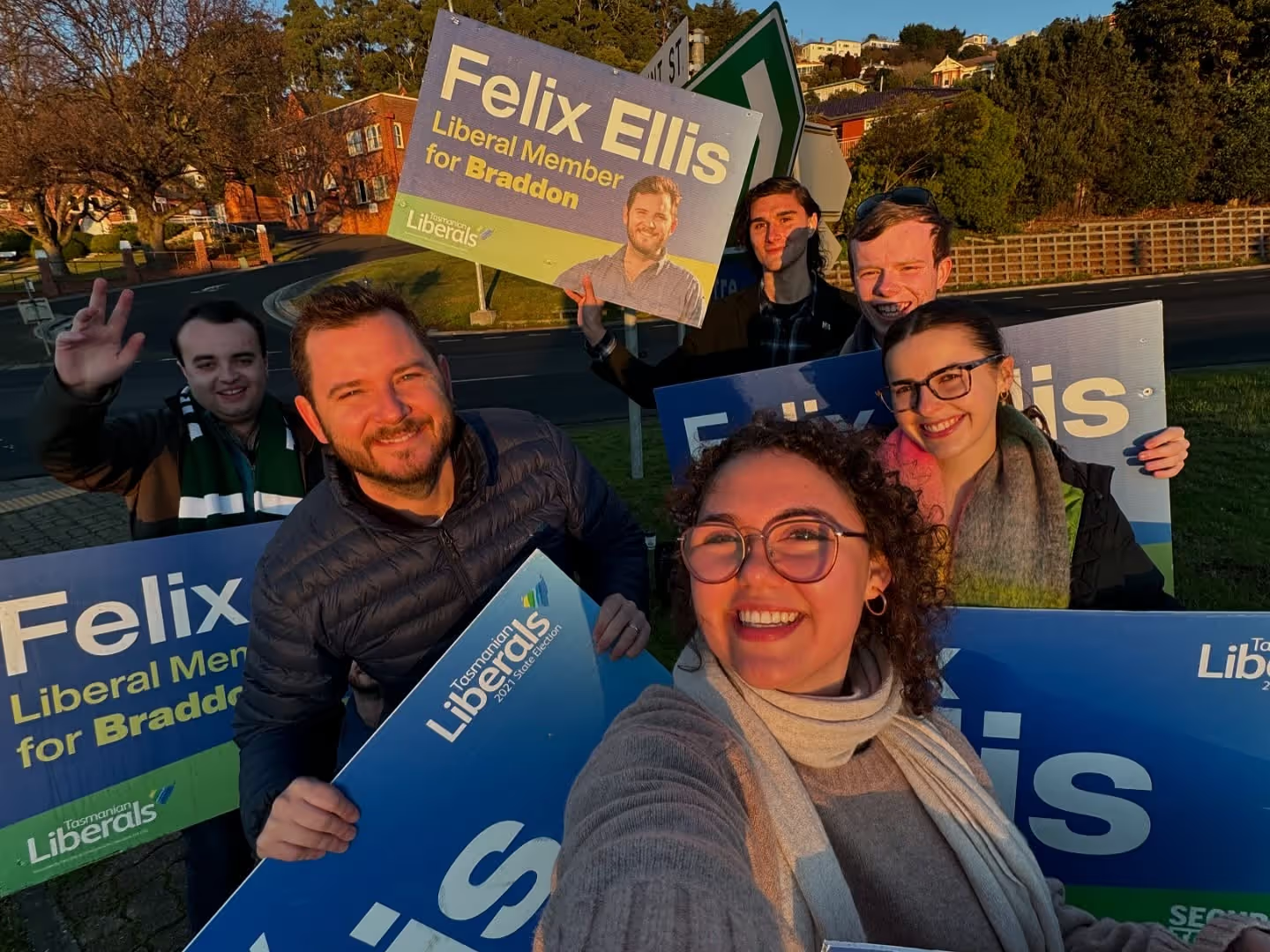
The numbers
As noted, young Australians now make up an increasing share of the electorate.
At the 2025 election, there were around 1.83 million enrolled voters aged 18-24, representing approximately 10.2% of the total roll.
Voters aged 25–34 accounted for a further 15-16% of enrolled voters.6 The 2025 election was also the first time that there were more millennial voters than baby boomers.7
Younger Australians are less likely to participate in formal civic and political organisations.
Participation in civic and political groups fell from 18.6% in 2006 to around 7% by 2020,8 with the sharpest declines among younger age cohorts.
Youth engagement has shifted strongly to digital platforms. Around one quarter of Australians now rely on social media as their main source of news,9 with usage highest among under-35s. Among Australians aged 18–24, Instagram and TikTok are the most commonly used platforms for news consumption,7 far exceeding print, radio or television.
The challenges
At the 2025 election, the Coalition’s primary vote among Millennials (born 1981–1996) fell to about 21 per cent.10 Generation Z also showed lower Coalition support (around 27 per cent).
Many young Australians believe the Liberal Party is less credible on issues of significance to them.
For example, young Australians are significantly more likely to rent,11 less likely to own property, and more pessimistic about future home ownership.
The Party is perceived to support existing asset holders and support older, wealthier Australians.12
Climate change remains a top-tier issue for under-35s, who perceive the Party as resistant to climate action relative to our opponents.
These brand perceptions among youth are now structural. They cannot be dismissed by saying voters will ‘age into’ voting for the Party.
Social media analysis from the 2025 campaign shows that influencers and social-first content were driving conversation and engagement,13 often reaching younger voters more effectively than traditional political messaging.
There are also challenges associated with engaging young people within the Liberal Party.
Given the above statistics regarding declining formal civic participation, some Party mechanisms appear misaligned with the habits of young people.
Traditional local branch structures rely heavily on meetings and time-intensive participation, which disadvantages students, casual workers and young professionals. Young Liberal pathways often lack visibility and accessibility.
How do we attract more young Australians to join our Party and vote Liberal?
To have your say on how we should address these challenges and strengthen our Party, please participate in our survey once you've finished reading read the Discussion Paper.
Next chapter
Footnotes:
3: Australian Bureau of Statistics, Australia’s population by country of birth, Jun 2024, ABS, Canberra, released 30 April 2025.
4: Australian Bureau of Statistics, Cultural diversity in Australia, ABS, Canberra, 2023.
5: Lowy Institute, Media use and news habits, Being Chinese in Australia 2023, Lowy Institute, Sydney.
6: Australian Electoral Commission, Record enrolment ahead of 2025 federal election, media release, 11 April 2025.
7: ABC, Election 2025: Gen Z, millennials now outnumber baby boomers, ABC News, 25 November 2024.
8: Australian Bureau of Statistics, General Social Survey: Summary results, Australia, 2023, Australian Bureau of Statistics, Canberra, released 13 December 2024.
9: News and Media Research Centre, Digital News Report: Australia 2025, University of Canberra, Canberra.
10: ABC, Millennials, Gen Z voters continue shift away from Coalition, ABC News, 11 November 2025.
11: Australian Bureau of Statistics, Housing occupancy and costs, Australia, 2023–24, Australian Bureau of Statistics, Canberra, released 18 December 2025.
12: Lowy Institute Poll, Lowy Institute Poll 2025 report, Lowy Institute Poll, 16 June 2025.
13: IT Brief, Social media influencers reshape narrative ahead of election, IT Brief, 2025.
